
Place Accumulator Horse Racing — How to Build a Place Acca
 Available in US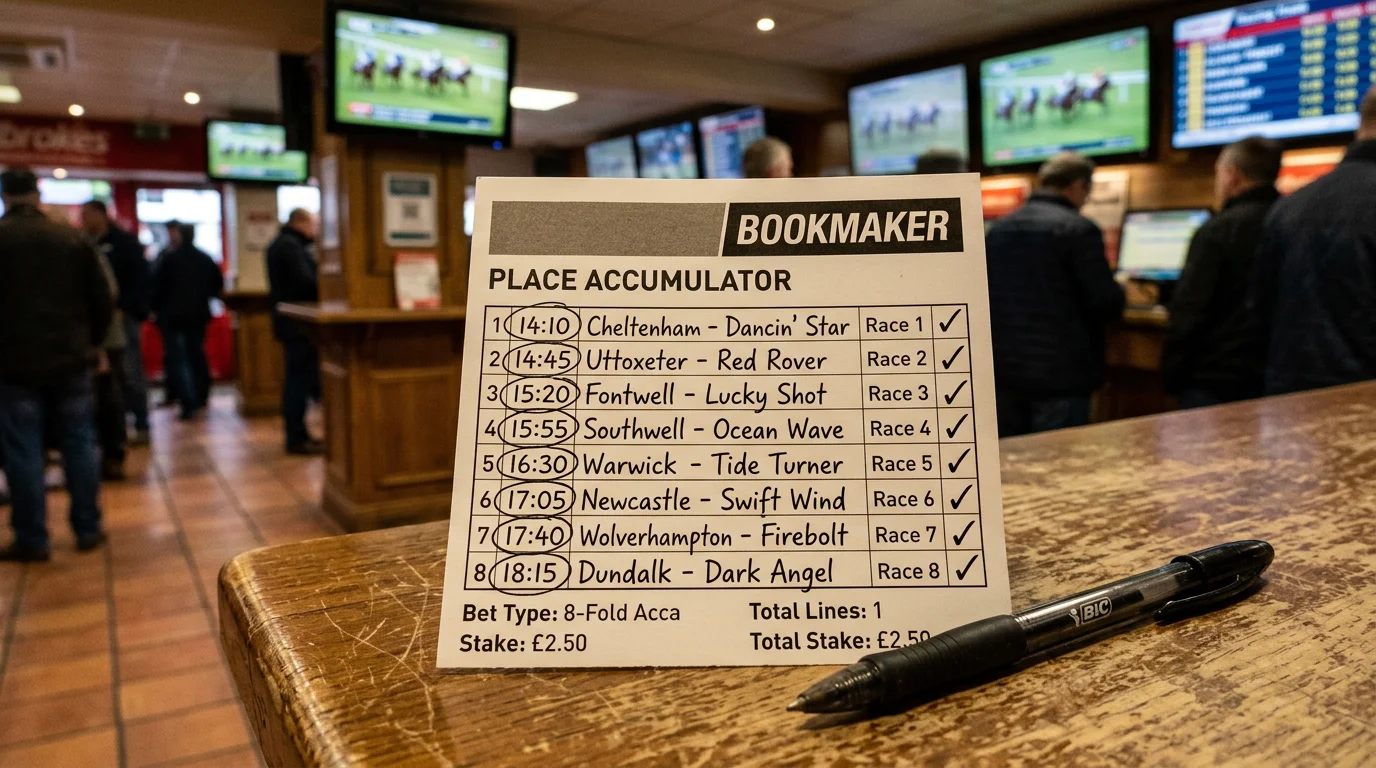
A place accumulator — or place acca — chains multiple place bets into a single wager where the returns from each successful leg roll forward into the next. Every selection must finish in the places for the bet to win. One failure anywhere in the chain and the entire acca is lost. The appeal is that place odds compound across multiple legs, producing returns that a single place bet at the same total stake could never match — while the higher strike rate of place bets compared to win bets means the acca is more likely to survive than its win-bet equivalent.
Place accumulators occupy a productive middle ground in UK horse racing: more rewarding than singles, more achievable than win accas. Building one effectively requires understanding the maths, selecting the right races, and knowing when to intervene with Cash Out before the final leg.
How a Place Accumulator Works
The mechanics follow the standard accumulator structure. You select horses in multiple races, each to place. The place odds from the first successful leg are multiplied by the place odds in the second, then the third, and so on. Your original stake is applied to the compounded odds.
Here is a four-fold place acca at £10. Leg 1: horse at 6/1 in a 14-runner handicap, place odds 1/4 of 6/1 = 6/4. Leg 2: horse at 8/1 in a 10-runner non-handicap, place odds 1/5 of 8/1 = 8/5. Leg 3: horse at 4/1 in a 6-runner race, place odds 1/4 of 4/1 = evens. Leg 4: horse at 10/1 in an 18-runner handicap, place odds 1/4 of 10/1 = 5/2.
The combined place odds: 6/4 × 8/5 × evens × 5/2. Converting to decimals: 2.50 × 2.60 × 2.00 × 3.50 = 45.50. On a £10 stake, total returns = £455.00. Profit: £445.00. Four horses finishing in the places — not winning, just placing — has generated a return that no single place bet could approach. That is the compounding effect at work, and it is why place accumulators are one of the most popular multi-leg bet types in UK racing.
The BHA 2025 Racing Report details the breadth of the UK racing product — over 1,400 fixtures a year — which provides ample opportunity to construct place accas across multiple meetings on the same day or across a Saturday’s feature card.
Place Acca vs Win Acca — Risk and Reward Compared
The fundamental difference is strike rate. A place bet wins more often than a win bet, because it covers multiple finishing positions. Grand National favourites, for instance, win approximately 24% of the time but finish in the top four around 58% of the time. That gap — replicated across every race in your acca — multiplies through the legs.
In a four-fold acca where each leg has a 50% place probability (a reasonable estimate for well-chosen place selections), the overall probability of all four placing is 0.50 × 0.50 × 0.50 × 0.50 = 6.25%. The same four legs as win bets at, say, 25% each would produce an overall probability of 0.39% — roughly sixteen times less likely. The place acca sacrifices per-leg odds for dramatically improved survivability.
The trade-off is in the payout. Win odds are higher, so a winning four-fold win acca pays substantially more than a winning four-fold place acca at the same stake. But the key comparison is expected value: how often does the bet win, multiplied by how much it pays? For selections with genuinely high place probabilities, the place acca’s combination of reasonable odds and realistic strike rate often produces a better expected return than the glamorous but rarely winning alternative.
Selecting Horses for a Place Accumulator
The quality of a place acca is determined entirely by the selections. Three criteria matter most.
Consistent placers over recent form. Horses with form figures showing regular top-four finishes — 2-3-1-4-2 rather than 1-0-0-8-1 — are the backbone of a place acca. The serial winner with occasional poor runs is a win-bet candidate. The serial placer is a place-acca selection. Look for horses that rarely finish outside the first four in recent starts.
Appropriate field size. Races with 12 or more runners in handicaps offer four paid places at 1/4 odds — the widest coverage and best fraction. With average field sizes at 8.90 on the Flat and 7.84 over Jumps in 2025, the biggest handicaps on any given day’s card are the natural hunting ground for place acca legs. Avoid building acca legs in five-to-seven-runner races where only two places pay — the narrow coverage dramatically increases the risk of a leg failing.
Race type alignment. Mixing leg types carelessly weakens the acca. A leg in a competitive 16-runner handicap (four places, 1/4) alongside a leg in a 9-runner Group 3 (three places, 1/5) creates an asymmetry: one leg has generous terms, the other tight ones. The strongest place accas draw most or all of their legs from the same tier of place terms, ensuring consistent coverage across the bet.
Managing Your Place Acca — Cash Out and Leg Tracking
Once a place accumulator is running, Cash Out becomes the most important management tool. Most major UK bookmakers offer Cash Out on place accas, and the timing of when you use it can define your return.
After three successful legs of a four-fold, the acca is carrying compounded value. The Cash Out offer at this point reflects the remaining leg’s place probability, discounted by the bookmaker’s margin. If the Cash Out offer is close to your calculated expected return from the final leg, taking it locks in a guaranteed profit. If the final leg looks strong and the Cash Out offer undervalues it, letting the bet run may be the better decision.
Track each leg individually as the results come in. Some bookmakers display acca progress in real time, showing which legs have landed and what the running return is. If a leg places but only barely — a dead heat for the last paid position, for instance — the place payout on that leg is reduced, which feeds into the compounded return. Knowing the status of each leg in real time prevents the unpleasant surprise of discovering your acca returned less than expected because of a dead heat settlement or a Rule 4 deduction buried in the middle of the chain.
One discipline separates successful place acca bettors from the rest: stake consistency. The temptation to increase the stake on a “strong” acca or reduce it on a speculative one undermines the long-term maths. Fixed stakes per acca, applied consistently across a season of betting, allow the compounding effect to work as intended and give you a clean dataset to evaluate your place-selection process.
The number of legs also warrants thought. A four-fold place acca offers a manageable balance between payout and probability. Moving to five or six legs increases the potential return but drops the overall strike rate sharply — each additional leg that must place erodes the cumulative probability, and the extra returns often do not compensate for the extra risk. For most place bettors, three-fold and four-fold accas hit the right balance. Doubles are the most achievable but return less, while anything beyond a five-fold enters lottery territory where the strike rate is too low to sustain over a season of regular betting.
Place Accumulator Horse Racing — More on this topic at place bet horse racing.
See also Starting Price vs Fixed Odds.
