
Ante-Post Place Betting — Rules, Risks & Value Guide
 Available in US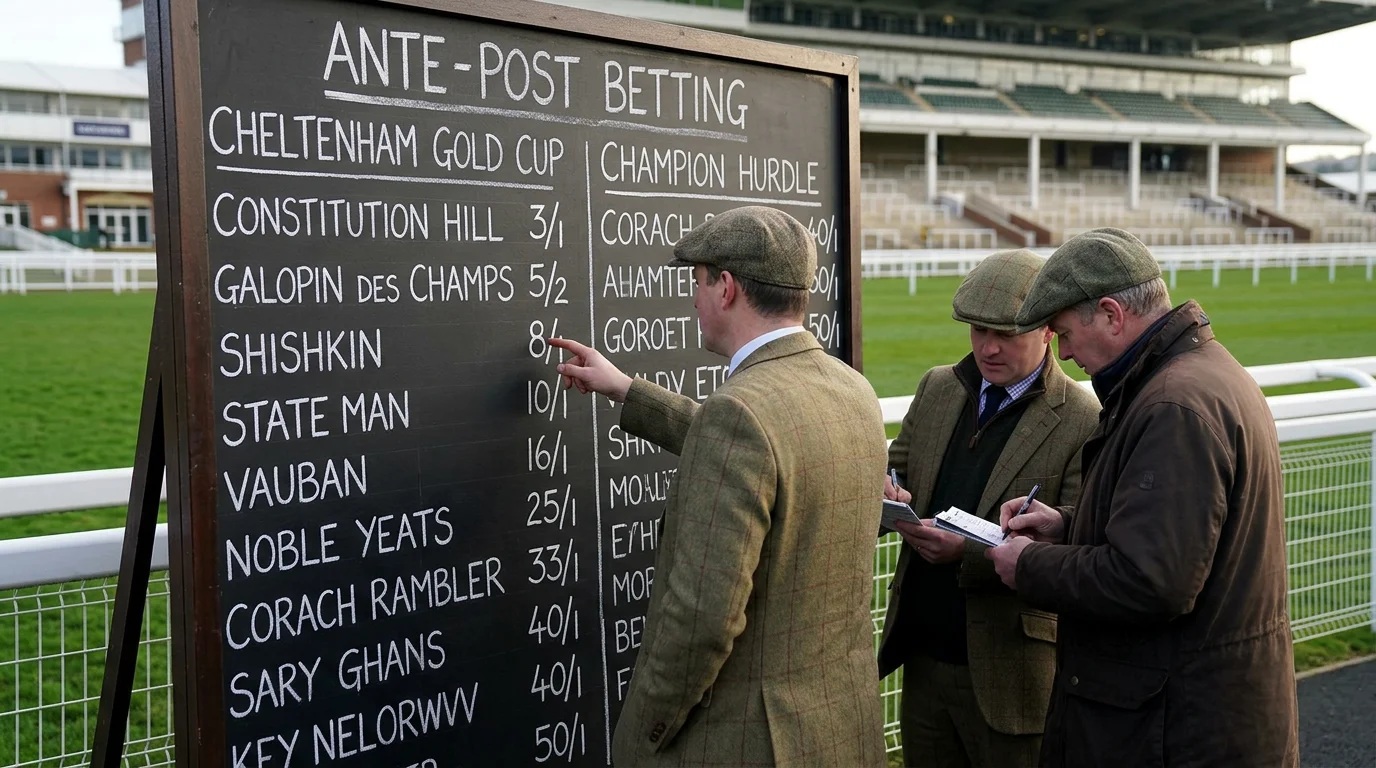
Ante-post place betting is the art of backing a horse to finish in the places weeks or months before a race takes place, locking in a price that is almost always more generous than what will be available on the day. The trade-off is risk: under standard ante-post rules, if your horse does not run, your stake is lost. There is no refund, no void, and no Rule 4 adjustment. You accept the possibility of losing everything in exchange for the price advantage that early commitment provides.
For place bettors, ante-post markets on major festivals — Cheltenham, the Grand National, Royal Ascot — offer some of the best value opportunities of the season. The place fractions applied to generous early win odds produce place payouts that day-of-race bettors simply cannot access. But the non-runner risk is real, and managing it is the central challenge of ante-post place betting in UK horse racing.
Ante-Post Place Bet Rules in UK Horse Racing
The defining rule of ante-post betting is simple and absolute: if your horse does not run, you lose your stake. This applies equally to win bets and place bets. There is no void, no refund, and no partial return. The bet is dead, and your money stays with the bookmaker.
This is the opposite of a day-of-race bet, where a non-runner triggers a refund on your selection (the bet is voided) and a Rule 4 deduction on the remaining runners. Ante-post bets are explicitly exempt from Rule 4. If you back a horse ante-post at 10/1 for the Gold Cup and three other horses are subsequently withdrawn, no deduction is applied to your payout. You get the full 10/1 if your horse runs and places. The exemption works both ways: you carry the non-runner risk on your own horse, but you are shielded from any Rule 4 erosion caused by other withdrawals.
Ante-post markets typically open months before a race, closing when the final declaration stage begins — usually 24 to 48 hours before the off. Any bet placed before that cutoff is classified as ante-post and governed by ante-post rules. Bets placed after final declarations are day-of-race bets, subject to standard non-runner and Rule 4 provisions.
The each-way component of an ante-post bet follows the same logic. If you back a horse each-way ante-post and it does not run, both the win and place stakes are lost. If it runs and places, the place part settles at the place fraction of the ante-post win odds you locked in — not the Starting Price, not the morning price, but the price you took weeks or months earlier.
The Price Advantage of Ante-Post Place Bets
The primary reason to bet ante-post is price. The earlier you commit, the more generous the odds tend to be, because the market has not yet absorbed the full weight of public money. A horse that opens at 16/1 in the ante-post market for a Cheltenham handicap might be 8/1 or shorter by race morning, once the betting public has piled in.
For place bettors, the amplification through the place fraction makes this even more impactful. At 16/1 with 1/4 odds, the place return is 4/1. At 8/1, the place return drops to 2/1. The ante-post bettor receives double the place payout of the day-of-race bettor, on the same horse, in the same race. That price gap is the core value proposition of ante-post place betting.
The scale of ante-post activity on major festivals is enormous. William Hill projected approximately £450 million in total wagering on the Cheltenham Festival 2026, with a significant portion of that flowing through ante-post markets in the weeks before the meeting. The demand for early positions in the market — from professional punters, syndicates, and informed recreational bettors — is what drives prices shorter as the race approaches. Betting early, before that compression occurs, is how you capture the value.
Risks of Ante-Post Place Betting
The non-runner risk is not abstract. Horses are withdrawn from races for a range of reasons, many of which are unpredictable at the time you place your bet.
Injury is the most common. A horse in full training can suffer a setback — a pulled muscle, a minor fracture, a respiratory issue — at any point between your bet and the race. The more time between your bet and the off, the longer the window for something to go wrong. Backing a horse in November for a March festival is a five-month exposure to injury risk.
Ground conditions are another factor. A trainer may decide, days before the race, that the going is unsuitable for their horse. A horse entered for the Champion Hurdle on Good ground might be withdrawn if the forecast turns to Heavy. Your ante-post bet does not care about the reason — the horse did not run, and your stake is gone.
The declining UK horse population adds a structural dimension. With horses in training down 2.3% to 21,728 in 2025, the pool of potential runners for any given race is shrinking. More horses chasing fewer available spots in top races increases the likelihood of supplementary entries, late switches between targets, and tactical withdrawals — all of which can turn your ante-post selection into a non-runner.
Mitigating Ante-Post Risk — NRNB and Timing
The single most effective mitigation is Non Runner No Bet. NRNB offers, available from most major bookmakers on selected ante-post markets, guarantee a full refund if your horse does not run. The prices under NRNB are typically slightly shorter than pure ante-post — the bookmaker is absorbing the non-runner risk and pricing accordingly — but still more generous than day-of-race odds.
Timing is the second lever. Betting too early exposes you to months of non-runner risk. Betting too late means the price has already compressed. The optimal window for most ante-post place bets on festival handicaps is two to four weeks before the race: close enough that the horse’s fitness and target are reasonably clear, but early enough that the public money has not yet fully arrived. For championship races with smaller fields and more certain runners, the window can extend further back, because the top horses tend to commit to their targets earlier.
A portfolio approach also helps. Rather than staking heavily on one ante-post place bet, spreading smaller stakes across three or four horses in the same race — each with a genuine place chance — reduces the impact of any single non-runner. If one is withdrawn, the others may still run. The overall cost is the same, but the risk of a complete wipeout is substantially lower. This is not hedging; it is diversification applied to an inherently uncertain market, and it is how serious ante-post bettors manage their exposure across a festival season.
Finally, monitor the training reports and declarations in the weeks before the race. Racing media — the Racing Post, At The Races, trainer interviews — regularly publish updates on intended runners for major festivals. A horse whose connections are publicly expressing confidence about their Cheltenham or Aintree target is a safer ante-post proposition than one whose trainer is equivocating about which race to enter. The information is freely available; using it to refine your ante-post positions is simply good practice. Ante-post place betting rewards patience, selectivity, and a willingness to act when the price, the information, and the NRNB protection align — and to walk away when they do not.
Ante-Post Place Betting — More on this topic at place bet horse racing.
See also Royal Ascot Place Betting.
