
Each Way Place Terms 2026 — Updated UK Bookmaker Rules
 Available in US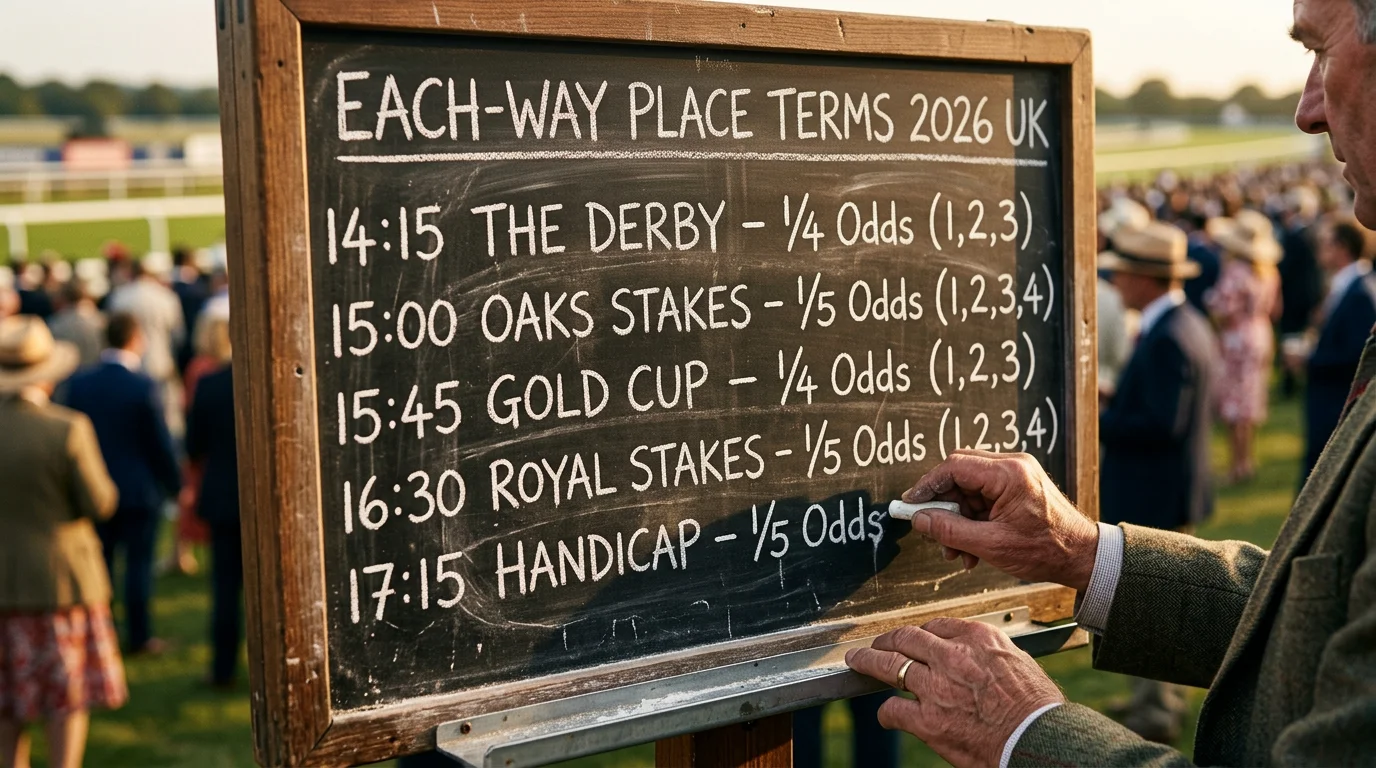
Each-way place terms determine how much of your stake goes toward the place part of the bet and what fraction of the win odds that part is settled at. These terms are not frozen in time. While the underlying Tattersalls rules that set the standard have remained stable for years, the bookmaker landscape around those rules shifts every season — promotions are added or withdrawn, enhanced terms appear and disappear, and broader commercial pressures reshape what bettors can expect.
For the 2026 season, the standard each-way terms remain unchanged from previous years. The five-tier structure based on runner count and race type is the same as it has been for as long as most bettors can remember. What has changed is the promotional layer above the standard — the extra places, the enhanced fractions, the Choose Your Place Terms features — and the economic forces that are pulling those promotions in different directions. This is the current state of each-way place terms for 2026, what to watch for, and how to ensure you are always betting on the best available terms.
Standard Each-Way Place Terms for 2026
The standard each-way place terms for 2026 are governed by Tattersalls Rule 3 and apply identically across all UK-licensed bookmakers as the default settlement basis.
The five tiers remain as follows: 1–4 runners offer win only with no place market; 5–7 runners pay two places at 1/4 odds; 8 or more runners in a non-handicap pay three places at 1/5 odds; 12–15 runners in a handicap pay three places at 1/4 odds; and 16 or more runners in a handicap pay four places at 1/4 odds.
These rules have not been revised for the 2026 season, and there is no indication that a change is forthcoming. Tattersalls rules evolve slowly, measured in decades rather than years. The last meaningful adjustment to the place terms structure was the standardisation of the 16+ handicap tier at four places, which has been in effect for long enough that most current bettors have never known anything different.
What this stability means for bettors is that the standard terms can be treated as a reliable baseline. Any promotional terms a bookmaker offers — extra places, enhanced fractions, custom place terms — sit on top of this foundation. If a promotion is not explicitly stated, the standard Tattersalls terms apply. There are no hidden changes or seasonal adjustments to the base rules in 2026.
Bookmaker-Specific Changes to Each-Way Terms in 2026
While the standard terms are static, the promotional environment around each-way betting continues to evolve — and in 2026, the direction is toward caution rather than generosity.
The primary driver is fiscal uncertainty. In 2025, the UK government proposed raising the tax on online betting from 15% to 21% on gross gambling yield. Although the Chancellor ultimately kept racing’s rate at 15% in the November 2025 budget, the threat highlighted the industry’s vulnerability. The BHA had estimated that an increase to 21% would cost the industry £330 million over five years, with knock-on effects for prize money, employment, and — critically for bettors — the promotional budgets that fund extra places, enhanced each-way terms, and Best Odds Guaranteed. The mere prospect of higher taxation has already prompted some operators to review their promotional spending.
In practical terms, this means several trends are worth monitoring. Some bookmakers have quietly reduced the frequency of extra places offers on midweek and lower-tier races, reserving them for festival handicaps and Saturday features where the marketing return is highest. Others have tightened the eligibility for enhanced each-way terms, applying them to selected races only rather than across the entire card. A handful have adjusted stake caps on promotional terms, meaning the enhanced deal applies only up to a certain bet size.
None of these changes has been dramatic enough to make headline news. The major bookmakers still compete vigorously on terms during Grand National week and the Cheltenham Festival. But the middle of the calendar — the ordinary Tuesday at Fontwell, the midweek evening card at Wolverhampton — is where the pullback is most visible. For bettors who spread their activity across the full racing calendar rather than concentrating on festivals, the 2026 season may feel marginally less generous than previous years on the promotional front.
How Terms Vary by Season — Flat vs Jumps
The Flat season (April to October) and the Jump season (November to April, with overlap in spring) produce different field size profiles, which directly affects which place terms tiers are most commonly in play.
Flat racing tends to produce slightly larger fields on average. The BHA reported an average Flat field size of 8.90 runners in 2025, compared to 7.84 for Jumps. This means Flat races more frequently clear the 8-runner threshold for three paid places, and the big Flat handicaps — at Royal Ascot, Goodwood, York — regularly trigger the 16+ handicap tier with four places. The Flat season is, in general, more fertile ground for place bettors seeking maximum coverage.
Jump racing fields are smaller on average but include some of the largest individual fields of the year. The Grand National (40 runners), Cheltenham Festival handicaps (15–24 runners), and selected Saturday features at Sandown or Kempton produce the biggest Jump fields. Outside of these marquee events, however, a typical midweek Jump card features novice chases and hurdles with 5–8 runners, often landing in the 5–7 runner tier where only two places are paid.
The seasonal pattern matters for betting rhythm. During the core Flat months (June through September), place bettors can expect a higher proportion of races offering three or four places. During the winter Jump season (December through February), the proportion of small-field, two-place races increases, and the big-field opportunities are more concentrated around specific meetings. Adjusting your activity — and your expectations — to reflect this seasonal cycle is a straightforward way to ensure your place bets are consistently placed under favourable terms.
How to Check Place Terms Before Every Bet
The single most effective habit a place bettor can develop is checking the place terms before every bet. It takes less than a minute and can prevent the frustration of discovering after the race that your horse finished in a position you thought was paid — but was not.
On most bookmaker websites and apps, the place terms for each race are displayed on the race card page, usually near the each-way toggle on the bet slip. Look for a line that reads something like “Each-way: 1/4 odds, 1-2-3” or “Place terms: 1/5, top 3.” This tells you the fraction and the number of paid places. If a promotional enhancement applies — extra places or an improved fraction — it will typically be flagged with a banner or icon alongside the standard terms.
Before the race, confirm the number of declared runners. If the field is sitting on a threshold (7/8 runners, 11/12 runners, 15/16 runners for handicaps), a single non-runner can change the terms. Most racing websites and apps update the runner count in real time once morning declarations are confirmed. Cross-referencing the declared runners against the place terms tiers takes seconds and gives you certainty about what you are betting into.
Finally, compare terms across bookmakers for any race where you plan a significant place bet. The standard Tattersalls terms are identical everywhere, but promotional enhancements are not. One bookmaker’s enhanced four places at 1/4 odds is another bookmaker’s standard three at 1/5. The five minutes spent checking two or three operators before confirming your bet is the highest return-on-time-invested activity in place betting.
Each Way Place Terms 2026 — More on this topic at place bet horse racing.
See also Place Bet Payout.
